Error Codes
In classical devices, high energy particles (cosmic rays, neutrons produced in the earth’s atmosphere, radiation from nuclear testing, radiation from particle accelerator) can strike computers and cause bits to flip from \(0\) to \(1\) or from \(1\) to \(0\). Some bits may also become corrupted when transmitted through the internet.
Similarly, quantum devices face errors due to noise (thermal fluctuations, electromagnetic interference, stray atoms, etc.), decoherence, and more. In this demonstration, we illustrate the concept of quantum error detection.
IBM Quantum Composer: https://quantum.ibm.com/composer/
1. Quantum Error
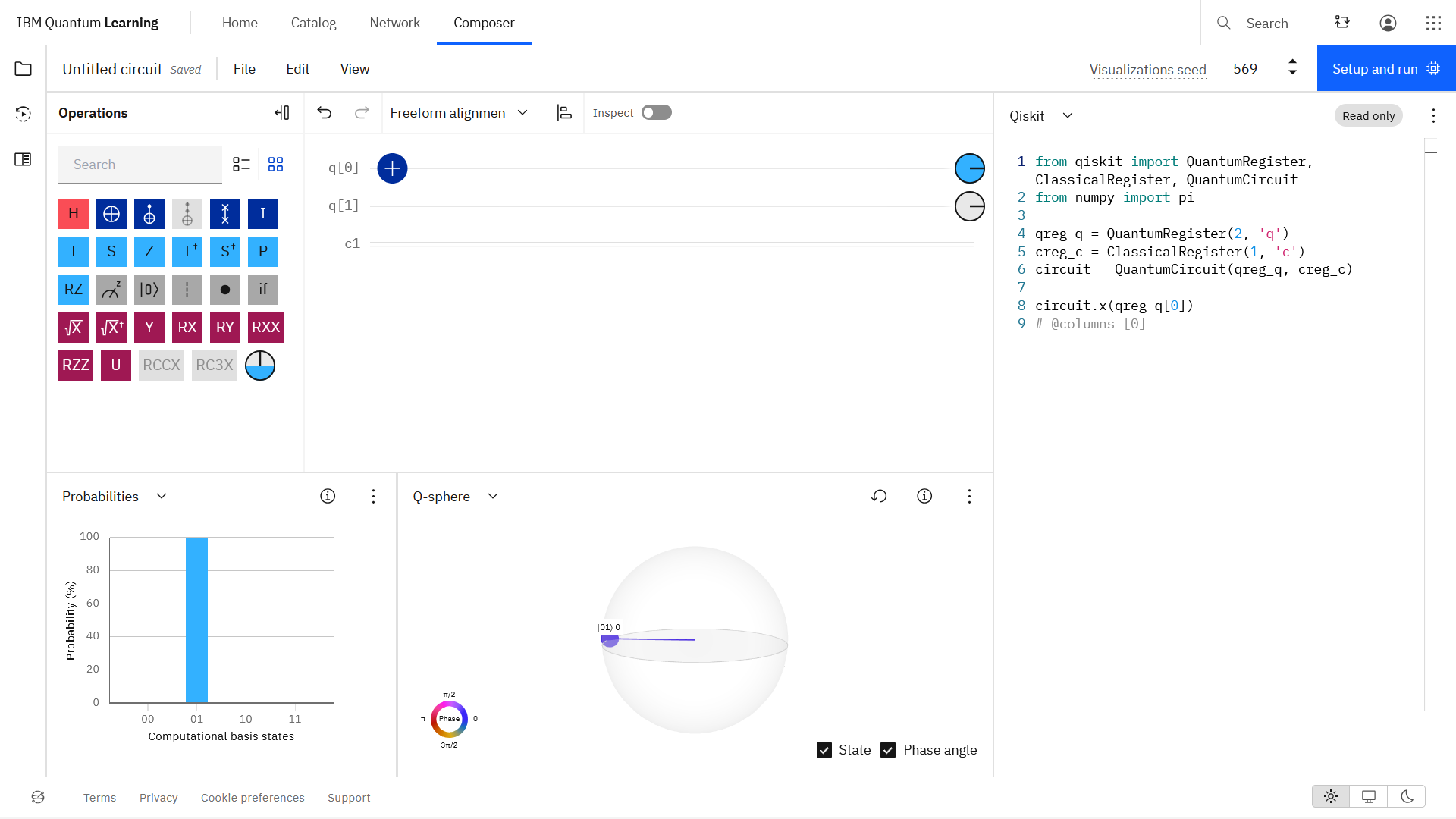
We will begin with the \(\ket{00}\) state. To simulate an simple bit flip error, we can simply apply an \(X\) gate to the second qubit. In more complicated cases, the qubit may experience partial bit flips or phase flips.
This results in the \(\ket{10}\) state.
2. Quantum Error Detection
Given that we know the original error-free state, we can detect if any changes in the state had occurred with parity checking. Parity refers to whether the bit string has an even or odd number of \(1\)’s. If there is an even number of \(1\)’s, the output is \(0\). If there is an odd number of \(1\)’s, the output is \(1\).
In this case, our original state is \(\ket{00}\). The parity of this state is \(0\).
To measure the parity without collapsing the original state, we add an ancilla (extra) qubit to store the parity. We apply \(\text{CNOT}\) gates to the circuit for every qubit, with that qubit as the control and the ancilla qubit as the target.
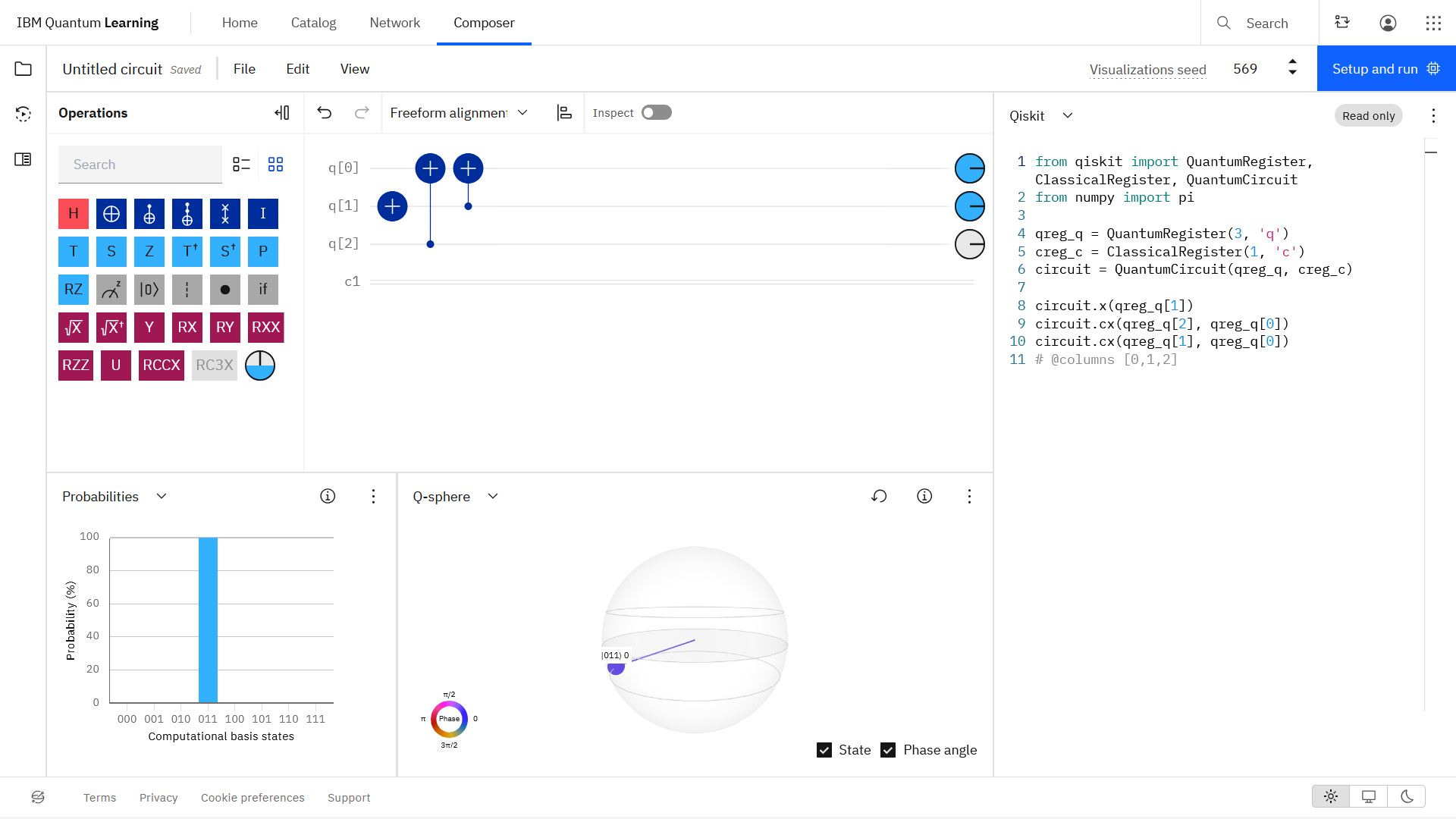
Measuring the ancilla qubit, we see the result to be \(\ket{1}\). This differs from our original known parity, \(0\). That means an error must have occurred.

3. Qiskit Implementation
We implement this in Qiskit.
[1]:
from qiskit import QuantumCircuit

# Create a quantum circuit with 3 qubits and 1 classical bit for measurement
qc = QuantumCircuit(3, 1)

# Step 1: Showcase simple error
# Initialize the qubits in the |00⟩ state

# Apply X gate to the second qubit to simulate a bit flip error
qc.x(1)  # Apply X gate to qubit 1 (second qubit)

# Step 2: Construct simple error detection (parity checking)
# Add parity checking using a third qubit (ancilla)

# Apply CNOT with qubit 0 (first qubit) as control and qubit 2 (third qubit) as target
qc.cx(2, 0)

# Apply CNOT with qubit 1 (second qubit) as control and qubit 2 (third qubit) as target
qc.cx(1, 0)

#Measure the ancilla qubit and store result in the classical bit
qc.measure(0, 0)

# Visualize the circuit
qc.draw(output='mpl')
[1]:

[2]:
from qiskit_aer import AerSimulator

simulator = AerSimulator()
job = simulator.run(qc, shots=1000) # How many copies of the circuit are executed

# Get the result and count the occurrences of each outcome
result = job.result()
counts = result.get_counts(qc)

print("Measurement results:", counts)
Measurement results: {'1': 1000}